

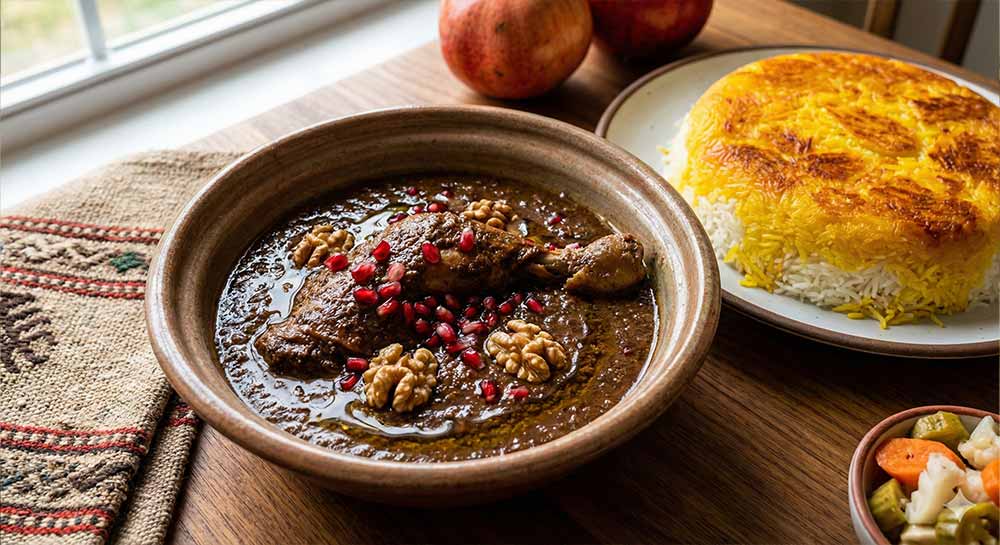
If we were to paint Persian cuisine with a single color, golden saffron might come to mind first. But if we are looking for “depth,” “history,” and “sophistication,” nothing rivals the dark, glossy mahogany hue of Fesenjan. Fesenjan (or Fesenjoon) is not just a stew; it is one of the oldest and most luxurious dishes on the Persian table, serving as a symbol of hospitality and grandeur for centuries.
In this article, we journey into the heart of Persian kitchens to uncover the secrets of this “flavor engineering.” How does the simple combination of walnuts and pomegranate create such magic?
1. Roots: A Dish from the Heart of History
Fesenjan is among the few dishes with roots tracing back to the ancient Persian Empire. Its core ingredients walnuts and pomegranates are both native to the Iranian plateau. In Persian culture, the pomegranate symbolizes immortality and fertility, while the walnut represents wisdom and abundance. The union of these two makes Fesenjan a symbolic dish for grand celebrations, weddings, and especially “Yalda Night” (the Winter Solstice celebration).
2. Kitchen Alchemy: The Secret of “Falling into Oil”
Many who see Fesenjan for the first time assume it is heavy with added oils or butter. However, the great secret of Fesenjan lies in “patience.” An authentic Fesenjan must simmer gently for hours (sometimes up to 8 hours). During this slow process, the finely ground walnuts release their natural oils. Iranians call this stage “Be Roghan Oftadan” (literally: falling into oil). This oil is pure, rich in Omega-3 and healthy plant fats, with absolutely no need for artificial oils.
3. The Sweet vs. Sour War: Which Palette Are You?
One of the most fascinating aspects of Fesenjan is its flavor adaptability based on geography. Almost every region in Iran signs this dish with its own unique signature:
- The Northern Version (Gilani): In Northern Iran, the birthplace of Fesenjan, the dish is cooked with sour, local pomegranate molasses and often features game birds like duck or goose. It is dark in color and sharply sour in taste.
- The Central Version (Tehrani): In the capital and central regions, a “Malas” (sweet-and-sour) taste is preferred. Chefs balance the tartness of the pomegranate by adding a touch of sugar, dates, or pumpkin.
- The Sweet Version: In some other regions, Fesenjan is served completely sweet, which has its own loyal fanbase.
4. Vegan Fesenjan: A Luxurious Plant-Based Option
While traditional recipes include chicken, duck, or meatballs (lamb/beef), the true identity of Fesenjan lies in its rich walnut sauce. Today, “Vegan Fesenjan” is one of the most popular items in modern Persian restaurants. By substituting meat with whole mushrooms, butternut squash, or plant-based meatballs, one can experience the exact same magical taste and creamy texture, without compromising on flavor.
Conclusion: A Taste You Must Experience
Fesenjan is a dish that surprises you with the very first spoonful. The granular texture of walnuts, the tangy smoothness of pomegranate sauce, and the subtle aroma of saffron create a symphony of flavors you won’t forget. At our restaurant, we are proud to serve this ancient heritage using the finest walnuts and homemade pomegranate molasses, cooked exactly the way grandmothers did, just for you.